Meet Dr. Stefanie
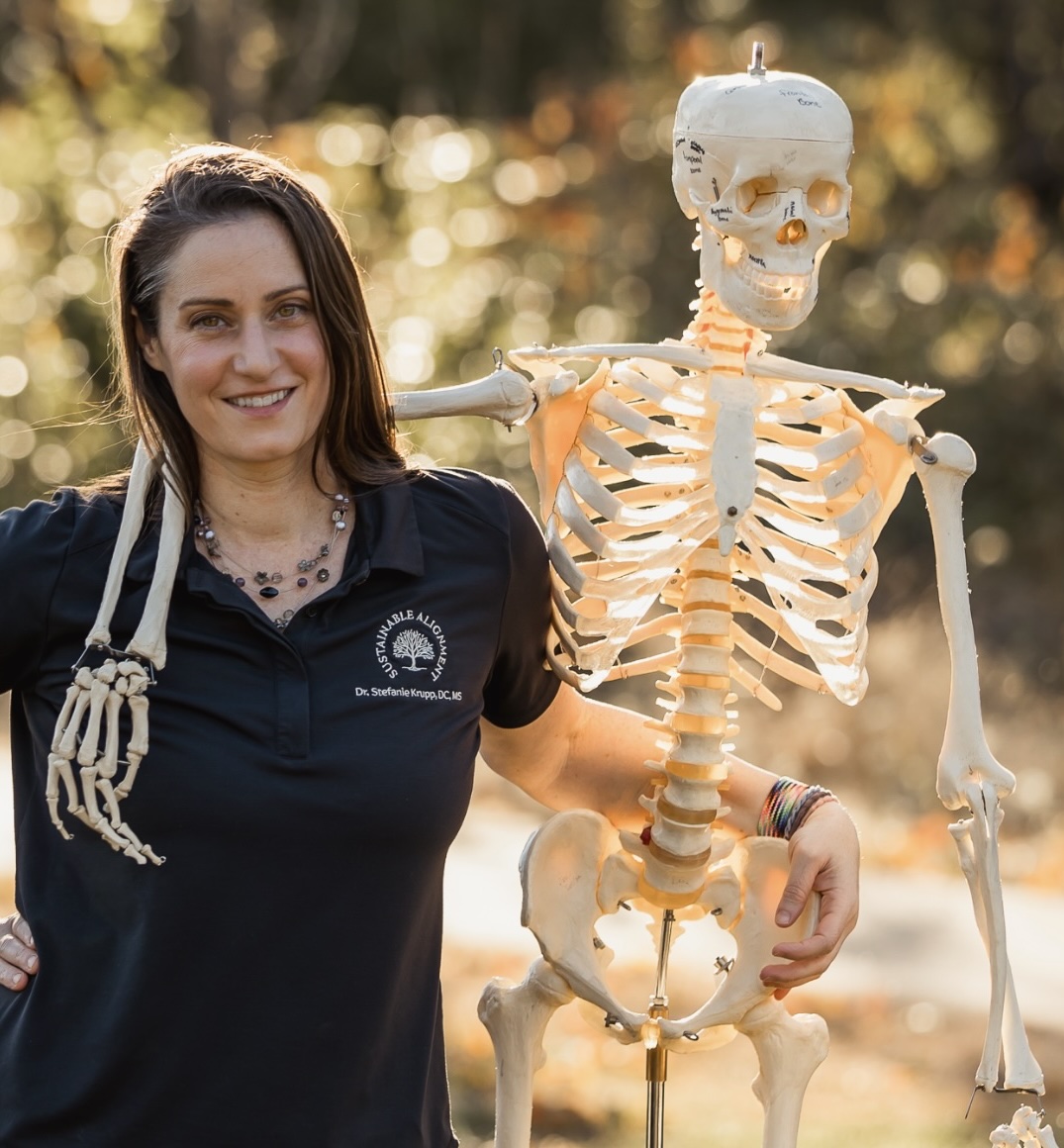
I grew up a bit busy. I played a lot of sports, tried music (flute actually), joined plays, attempted singing in the school choir, was in the Girl Scouts, wondering how to become well-rounded and losing bits of myself in all of it. I pushed through injuries because that was what you did. Soccer, field hockey, lacrosse, basketball, softball, track. I didn't ask for help. I managed.
By the time I was twenty, things had accumulated in ways I didn't have language for. I was told by healthcare providers I would have to live with the pain and degeneration from those old injuries. That stress and overuse had their consequences and I should adjust my expectations. So I worked hard to put myself through college and accepted that it hurt to go up and down the stairs to my apartment, and became a bit afraid to make it all worse.
Then I walked into a different doctor's office. A chiropractor in Upstate New York carefully assessed everything other providers had dismissed. Things stopped hurting. He resolved injuries I had been told were permanent. And then he said something that changed the direction of my life: he told me I would make a great doctor, because healthcare needs educators.
That sent me back to school, this time for chiropractic. I had spent years studying mathematics because I believed math was the language of nature, the underlying pattern in everything. I discovered it applied directly to the human body. The numbers on your lab work, your wearable, your scale, they are not just data points. They are your body's language, and most people were never taught how to read it.
When I learned how the body really worked in graduate school, I finally had a framework to understand what my body had been trying to tell me all along. And I was frustrated. Frustrated that it took two graduate degrees to build the connection with my own body that every one of us needs just to live well. This one body, day in and day out. That frustration became a question I couldn't stop asking: why aren't people taught this? Why should it take a doctoral degree to understand how your own biology works?
The windy path, where all of it matters:
I studied sociolinguistics at the University of Pennsylvania because language shapes how we understand the world. I pursued mathematics at Hartwick College because math is the language of nature, the underlying pattern in everything. That path led me to chiropractic school, where I earned a Doctor of Chiropractic and a Master's in Applied Clinical Nutrition, both with honors, because I wanted to understand the full picture of how a human body builds, breaks down, and heals.
My career has spanned faculty clinical practice and college instruction, research and publications, quality improvement (Lean Six Sigma Black Belt), technology project management, and work in state and local public health and health systems.
That path mattered. All of it is in this practice and in the room with you. The sociolinguistics is in how I listen to what you say and what you don't. The mathematics is in how I read patterns and structure care around the data our world increasingly provides. The education is how you learn to own your body. The nutrition is in how I see the raw ingredients needed to build and rebuild your body. The quality improvement is in how I structure our time together, iterating on health improvements, guiding you toward sustainable alignment. The public health and health systems background is in how I understand how and why the system isn't working, from the inside out.
CREDENTIALS AND BACKGROUND
Education
- Doctor of Chiropractic (DC), honors, New York Chiropractic College
- Master of Science in Applied Clinical Nutrition (MS), honors, New York Chiropractic College
- Bachelor of Arts in Mathematics, magna cum laude, Hartwick College
- Associate's in Arts, Sociolinguistics, University of Pennsylvania
Most clinicians train in one lane. Mathematics builds the capacity to find underlying structure before accepting surface explanations. Sociolinguistics is the study of how language shapes meaning, which matters when you are explaining a complex health picture to someone who has never had it explained well. The clinical and nutrition training followed. The result is a clinician who thinks in systems and does not mistake a symptom for the full story.
Certifications
Lean Six Sigma Black Belt
Most people hear "quality improvement" and think corporate process charts. What it actually means in practice: I am trained to find where systems fail, measure what is really happening versus what people assume is happening, and redesign the process around what the data shows. That is how I approach a care plan. Not a protocol applied to everyone, but a structured, iterative arc built around your specific patterns and what is actually changing.
Institute for Healthcare Improvement (IHI) Certificates in Patient Safety and Quality & Safety
Safety in healthcare fails at the system level long before it fails at the individual level. This training is in how to see those failure points and build around them. It is why I ask the questions I ask, document the way I document, and think about your care the way I think about it.
Certified Ergonomic Assessor
This one shows up every time someone sits down in front of me. How you hold yourself at a desk, in a car, or at a workstation tells a story. An ergonomics assessment finds it and fixes it. Chair height, monitor position, steering wheel angle, keyboard placement, small adjustments that change what your spine and nervous system are dealing with every single day.
Published Research and Scholarship
- 4 chapters, Praeger Handbook of Chiropractic Health Care (Praeger/ABC-CLIO, 2016-2017), the field's reference text on chiropractic education and career development
- Schimp D, Krupp S. Life-Threatening Lower Back Pain: Decoding the Mystery Step-by-Step. 2016; a clinical decision-making algorithm for identifying serious pathology in low back pain presentations. Available at chiro.org
- Peer-reviewed publication: Conservative treatment of chronic ankle arthropathy. Topics in Integrative Health Care, 2014
- Tan PL, Barr T, Inglis PN, Krupp S, et al. Loss of Bardet Biedl Syndrome Proteins Causes Defects in Peripheral Sensory Innervation and Function. Proceedings of the National Academy of Sciences (PNAS), 2007; 104(44):17524-9.
- Peer reviewer, Association of Chiropractic Colleges Research Agenda Conference
- Presented at Palmer Chiropractic College, Oregon Collaborative for Integrated Medicine, and ACCRAC
The research spans computational neuroscience, clinical case work, chiropractic education, and public health. None of it started from a single lane. It started from following questions that mattered, about how the body works, how clinicians learn, and how care fails people when the system around it isn't built well. That is still what drives the work.
Teaching and Clinical Education
- Attending Clinician and Assistant Professor, Texas Chiropractic College
- Faculty, Northwest Center for Lifestyle and Functional Medicine, University of Western States
- Executive Director, Center for Academic Development and Innovation, University of Western States
- Adjunct Instructor, General Nutrition, Clark College
- Designer and Facilitator, ScreenWise Professional Learning Collaborative, Oregon Health Authority; a 12-organization learning community for Federally Qualified Health Centers implementing CDC-funded breast and cervical cancer screening programs statewide
Teaching has been part of this work since the beginning. Not just delivering content in a classroom, but building the systems that support how clinicians and students actually learn. Course design, faculty development, clinical supervision, academic assessment, online instruction. The thread through all of it: people learn best when the structure around them is built intentionally and the teacher is genuinely curious about whether it is working.
Context is where health actually lives. What I see in the office is one data point. What you go back to after the visit, your car, your desk, your kitchen, your sleep environment, your stress load, the way you sit for eight hours a day, that is the fuller picture. I cannot truly help you without understanding the context I am sending you back into. That is why this practice extends beyond the adjustment table, and why the work we do together is always about your whole life, not just the hour you spend here.
Public Health and Systems Work
- Oregon Health Authority, Public Health Division
- Quality Improvement Coordinator, Office of the State Public Health Director
- Data Specialist, Maternal and Child Health
- Health Systems Coordinator, ScreenWise Breast and Cervical Cancer Screening Program
- Public Health Operations Supervisor, Marion County Health and Human Services, Salem, OR
- Enterprise Training and Adoption Consultant, Legacy Health System, Portland, OR
Most of what shapes your health never happens in a clinical setting. Working inside state and county health systems taught me that the system is built to manage illness, not prevent it. That is the reason this practice is built differently.
Service, Community Education, and Advisory Work
- Supervising clinician, service learning trips to Costa Rica, two trips, Texas Chiropractic College
- Nutrition assessment fieldwork in hill tribe villages, northern Thailand, Hartwick College
- Advisory Board, BS in Health Sciences, Southern California University of Health Sciences
Community health education presentations on nutrition, movement, ergonomics, and wellness delivered to schools, worksite wellness programs, community health events in Pennsylvania, Texas, Oregon, and the Pacific Northwest. Topics included women's health and nutrition, ergonomics, range of motion, healthy eating, and what chiropractic care actually is and does.